
forbinfi
Updated Thu October 15, 2026
Published Under: BrandingEmployee Spotlight

Maddie Naeve joined the forbinfi team in 2023 as an intern and has since moved into the role of Visual and Brand Designer.
From social graphics and marketing campaigns to print materials and brand development, Maddie helps financial institutions communicate visually. While her professional life revolves around design, her creativity doesn’t stop when the workday ends.
“I love to craft,” Maddie says. “Specifically, fiber art. I love crochet, embroidery, and sewing!”
She’s also fascinated by storytelling in another visual form: film.
“I love movies and learning about the process behind producing and marketing film. I’ve been really loving learning about the production of Christopher Nolan’s The Odyssey.”
Whether she’s learning about film production or designing a campaign for a community bank or credit union, one principle remains the same: thoughtful design helps people connect with a story.
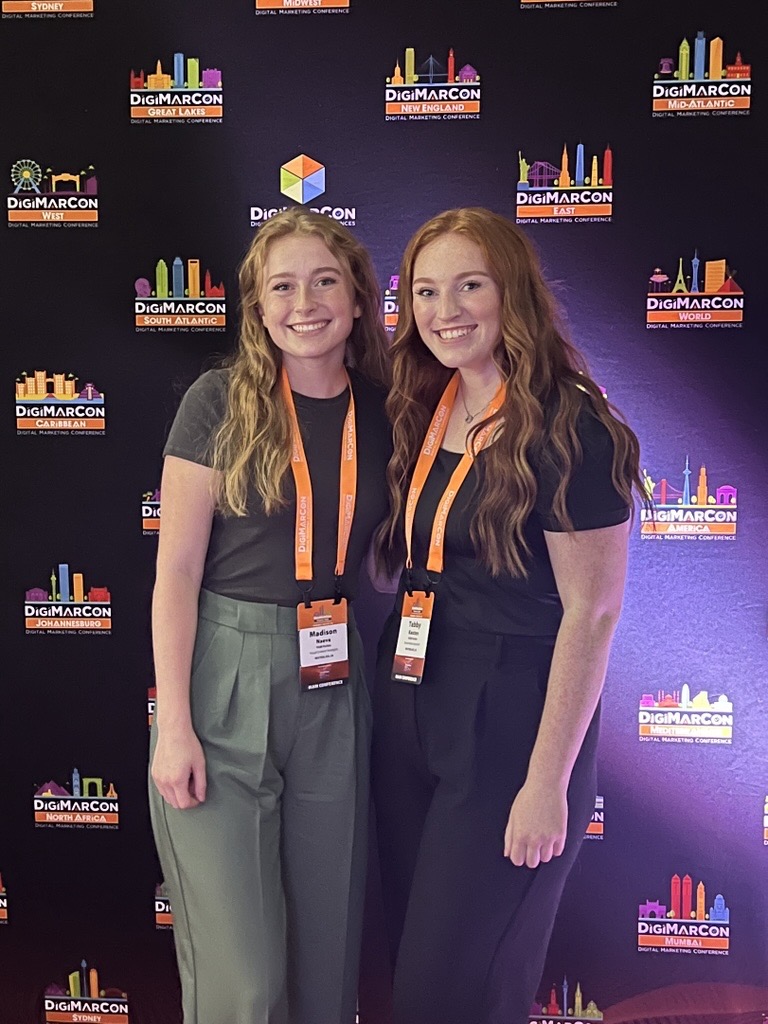
Connecting creativity and digital marketing at DigiMarCon.
Maddie’s Creative Snapshot
Role
Visual and Brand Designer
Creative Interests
Crochet, embroidery, sewing, and film
Favorite Design Topic
Brand guidelines
Advice for Clients
Don’t be afraid to step in front of the camera
From Social Graphics to Strategic Campaigns
Since joining forbinfi, Maddie’s role has evolved significantly.
“I started as a designer focusing on social graphics for our clients, and now I’ve pivoted towards print marketing and campaign-specific work.”
This transition has given her a broader perspective on how individual designs work together across a campaign.
A social media graphic may be one small part of a larger effort that also includes email, website content, digital advertising, landing pages, direct mail, or branch materials. When the visual details remain consistent, each piece reinforces the same message and strengthens the overall campaign.
Why Branding Matters
When asked which aspect of her work she could nerd out about, Maddie’s answer is brand guidelines.
“Brand guidelines are so important,” she emphasizes. “Your FI needs strict guidelines for visual graphics.”
Brand guidelines may seem restrictive, but they create the consistency that helps customers recognize your financial institution across different platforms and materials.
Maddie’s Take: “After looking at your marketing materials, it may seem like everything looks the same, but that’s exactly what you need to be recognizable for clients. You can still be creative, but find ways to be creative while following your branding.”
Following brand guidelines means the colors, fonts, imagery, logos, and other design choices should feel like they belong to the same institution.
When you’re one of many financial institutions offering similar products and services, consistent visual branding helps build familiarity—and trust—over time.
Representing the Real People Behind the Brand
When asked what makes a financial institution’s branding memorable, Maddie doesn’t mention logos, colors, or fonts first.
Her answer?
“Photos of your FI’s team.”
For community banks and credit unions, relationships remain one of the strongest differentiators. Showing the faces behind the brand reminds customers and members that real people are available to help them navigate important financial decisions.
“In the digital age, it’s so important to remind your community that there are real people there to support their financials,” Maddie says.
Maddie’s content ideas for financial institutions reflect that people-first philosophy:
The most effective, engaging content often centers on real people and real stories. Plus, it gives your financial institution opportunities to share your knowledge, culture, history, and community involvement.
People-First Design Reminder
Customers can find stock photography anywhere. The people, experiences, and local connections behind your institution are uniquely yours.
How AI Has Influenced Graphic Design
A hot topic in the marketing world right now is, “Why can’t we do this ourselves with AI?”
Maddie sees AI as a creative resource rather than a creative replacement for a designer’s judgment, knowledge, and perspective. She uses it early in the creative process to brainstorm how to lay out designs and explore possible directions.
“When I use AI, I try to use it more as inspiration, then apply different ideas to my work.”
AI may provide a starting point, but the final design still requires a human understanding of the institution, its audience, its brand standards, and what the campaign needs to communicate.
Maddie then evaluates the ideas, refines the visual direction, and makes sure the finished work fits both the client and the larger campaign.
Maddie’s Parting Words of Wisdom
If there’s one final tidbit of wisdom Maddie wants to impart on our financial clients, it’s to embrace the camera.
“Don’t be afraid to be in front of the camera. Showcasing your FI’s team in your photos and videos is so valuable.”
Community financial institutions rely on relationships. While products and services may look similar from one institution to another, your people, culture, and community connections are uniquely yours.
Featuring employees in photos, videos, expert tips, and community stories gives current and prospective customers a better sense of who they’ll be working with before they ever walk into a branch.
That’s a connection stock photography alone can’t create.
Bring Your Financial Institution’s Brand to Life
Thoughtful design can help your institution feel recognizable across social media, email, print, website content, and integrated marketing campaigns.
Comments